
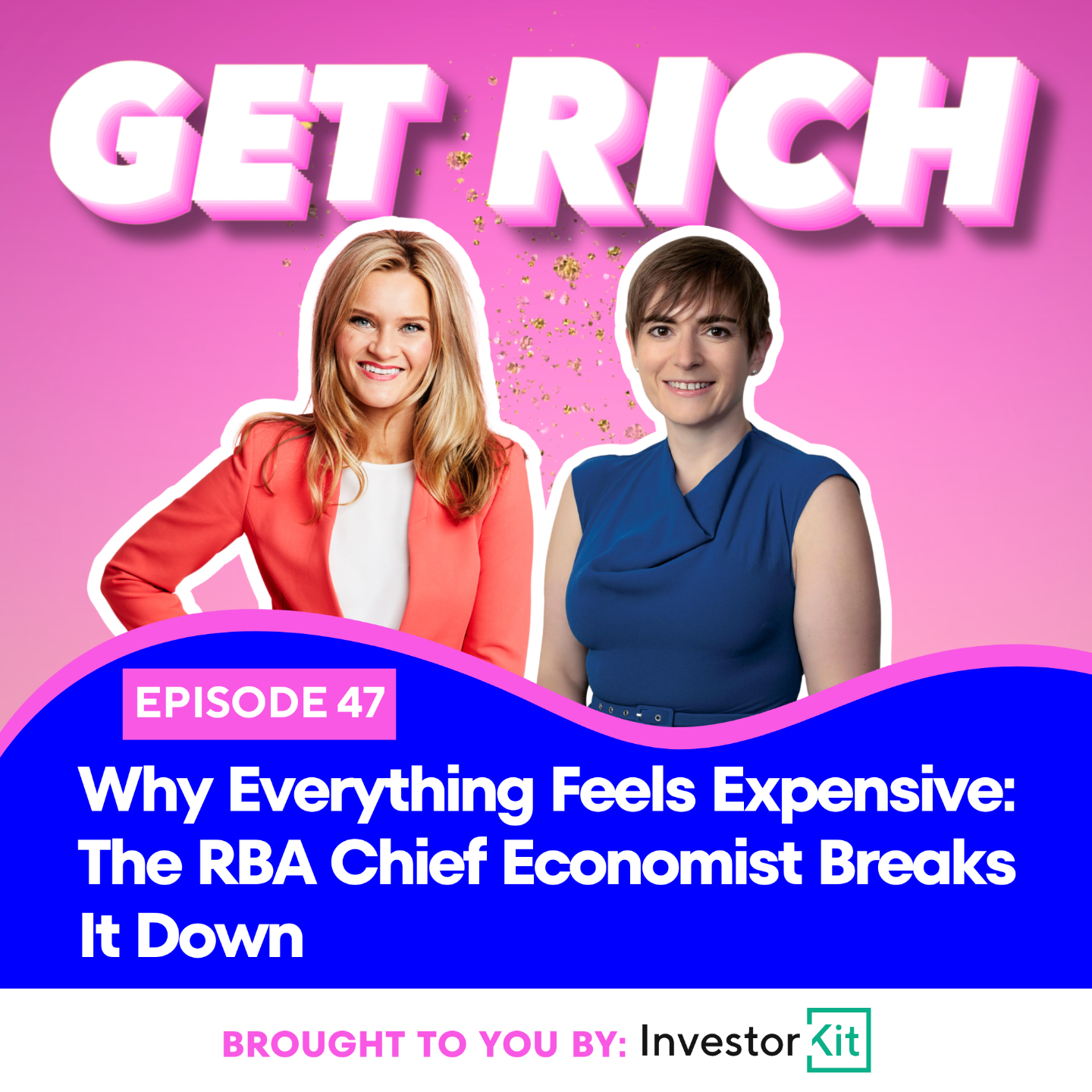
Episode 47
Why Everything Feels Expensive: The RBA Chief Economist Breaks It Down
Episode Description
Why Everything Feels Expensive: The RBA Chief Economist Breaks It Down
Struggling to understand why groceries, rent and bills feel so expensive right now? You’re not alone and in this episode, we break it all down in plain English.
Molly sits down with Sarah Hunter, Chief Economist and Assistant Governor (Economic) at the Reserve Bank of Australia (RBA), to demystify inflation, interest rates and what’s actually happening in the Australian economy.
Together, they unpack:
✨ What inflation really means (and why it’s not as simple as “prices going down”)
✨ What’s inside the CPI “basket” and why it never feels like the average fits your life
✨ Why the RBA targets 2–3 percent inflation
✨ How interest rates are set and who actually sets them
✨ How inflation affects your mortgage, savings and everyday budget
✨ Why global events like wars and supply shocks hit your hip pocket
✨ What to expect for inflation and the economy heading into 2026
✨ Practical steps you can take to prepare for rising costs
If you’ve ever wondered:
“Why is everything getting more expensive?”
“What does the RBA actually do?”
“Should I be worried about inflation?”
…this episode is your go-to explainer. No jargon. No doom and gloom. Just clarity.
🎧 Listen now and finally understand inflation in a way that makes sense for real life.
If you totally missed Economics 101 at school (same 🙋♀️), then you’re going to love this week’s episode of Get Rich.
This episode is brought to you by InvestorKit, Australia’s #1 Buyers Agency for 2023 and 2024. They specialise in helping investors find high-growth properties utilising industry leading AI and data driven research process across Australia. 70%+ of the properties they purchase are off-market and they have consistently outperformed national average capital growth rates by over 49%. Whether you’re looking to build your property portfolio or secure your first investment. Check them out here.
CHAPTERS
00:00 - Welcome to Get Rich
00:01 - The RBA Interview, A Full-Circle Moment
00:02 - Inflation 101, What It Is, And Where It’s At
00:04 - What’s Inside CPI, And Why It Doesn’t Match Everyone
00:05 - Is Inflation “Good” Or “Bad”, The 2–3% Goal
00:06 - The Shopping Trolley Test (Coles Example)
00:07 - If Inflation Falls, Do Prices Fall Too
00:08 - The Macca’s Cone, Why Prices Rise
00:09 - Inflation, Savings, Mortgages, And Interest Rates
00:10 - Who Sets Interest Rates, Cash Rate vs Bank Rates
00:13 - Recession Explained, And How It Connects
00:15 - How Global Events Flow Into Aussie Inflation
00:17 - Banana Shock, A Simple Supply Story
00:19 - Wages vs Inflation, Are You Really Getting Ahead
00:21 - What The RBA Actually Does (Beyond Rates)
00:23 - Do Central Banks Talk To Each Other
00:24 - Why The Target Is 2–3%
00:25 - 2026 Outlook, What Sarah’s Watching
00:27 - Practical Planning, Electricity Rebates Ending
00:28 - Wrap Up and Thanks
LINKS FROM THE EPISODE
Reserve Bank of Australia (RBA) – Official Site – for cash rate targets, inflation, and monetary policy basics: https://www.rba.gov.au
RBA Media Releases & Decisions – latest official RBA rate announcements (e.g., December 2025 decision to hold at 3.60%): https://www.rba.gov.au/media-releases/2025/mr-25-33.html?
RBA Measures of Consumer Price Inflation (CPI) – how inflation is measured and tracked: https://www.rba.gov.au/inflation/measures-cpi.html
Australian Bureau of Statistics (ABS) – Consumer Price Index data – latest CPI figures and detailed inflation breakdown: https://www.abs.gov.au/statistics/economy/price-indexes-and-inflation/consumer-price-index-australia/latest-release
RBA Cash Rate Tracker (via ASX) – market expectations for future RBA rate moves: https://www.asx.com.au/markets/trade-our-derivatives-market/futures-market/rba-rate-tracker
CONNECT WITH SARAH HUNTER
Website: Sarah Hunter - Assistant Governor (Economic) | RBA
LinkedIn: linkedin.com/in/sarah-hunter-42526541
CONNECT WITH LADIES FINANCE CLUB
Join our free Facebook group - Ladies Finance Club Money Chat
Website: https://www.ladiesfinanceclub.com/
Instagram: https://www.instagram.com/ladiesfinanceclub/
LinkedIn: https://www.linkedin.com/company/ladies-finance-club/
Show Notes
TAKEAWAYS
- The Reserve Bank started raising interest rates in May 2022.
- The last rate rise occurred in November 2023.
- The goal was to slow down the economy to manage inflation.
- High demand can lead to inflation if not matched by supply.
- Businesses were trying to invest and expand simultaneously.
- Inflation is a result of pressure in the economic system.
- COVID-19 significantly impacted economic recovery efforts.
- Interest rates are a tool to control inflation.
- Understanding economic dynamics is crucial for policy-making.
- The balance between demand and supply is essential for price stability.
SOUND BITES
"We were raising the interest rate."
"Slow the economy down a bit."
"Demand running stronger than supply."
TRANSCRIPT
[00:00:00] Molly: Welcome to Get Rich, the podcast that helps you do just that. Get rich and stay rich. Hey, I'm Molly Benjamin. I'm the founder of Ladies Finance Club, one of Australia's largest financial education platforms for women. But before I started helping thousands of women take control with their money, I was a hot financial mess when it came to my own finances and not the fun kind of hot, more like crying in a supermarket, wondering where all my money went kind of hot.
[00:00:29] But here's the thing, if I can go from financial mess to owning a share portfolio, investing in property, and building wealth. Then you can too. My mission is simple to make women rich because when we have financial freedom, we have choices, confidence, and control over our future. Every week on Get Rich, I sit down with some of the best experts in the industry to break down how we can all start investing, growing our money.
[00:00:56] And creating long-term financial security without the jargon, boring bits or overwhelm. Because when women get rich, we don't just change our lives, we change the world. So if you're ready to start making some smart money moves, hit that subscribe button and let's get rich together.
[00:01:15] Welcome back to a special episode of Get Rich, the podcast that helps you do just that. Get rich and stay rich. I'm Molly Benjamin, your host and founder of Ladies Finance Club. Now, when I started LFC Ladies Finance Club, a lot of you know I was broke living in London, me a laptop. Big dreams. So it felt pretty surreal when the Reserve Bank of Australia reached out and asked if I would like to interview their chief economist about inflation.
[00:01:42] I was like, um, yes, please. But it also just shows me like moments like this remind me how far we've actually come at Ladies Finance Club like. Never imagined we'd grow into a community of tens of thousands of women in Australia, or that I'd be chatting to the RBA. So if you've got a dream stick with it.
[00:02:00] Keep going. You have no idea what doors will open. Now in Felician, it's one of those concepts that everyone talks about, but. I don't know if we fully understand it and there's no shame, it can definitely be confusing. So in this episode, I speak to Sarah Hunter for the RBA, and as I said, she's the chief economist assistant governor, and she's so smart.
[00:02:20] She's been to Oxford and Cambridge, that she was so lovely and she really helped me understand what inflation is, why it matters. Why things feel expensive and how to actually, it all connects with your mortgage, the cash rate, your savings. So if you've ever thought, wait, Molly, what is inflation? Again, this episode is gonna give you a lot of clarity.
[00:02:42] As always, we'd love to hear your feedback. So send me a DM or just reach out to us@ladiesplanetclub.com. All right, let's get into it. Welcome to the Get Rich Podcast. Sarah, we're excited to have you on to learn about all things RBA and inflation.
[00:02:59] Sarah: Oh, thank you so much for having me. I'm looking forward to it.
[00:03:01] So I actually
[00:03:02] Molly: thought, you know, what's a good place to start? Well, let's actually start with what actually is inflation and what is inflation at the moment?
[00:03:10] Sarah: Yeah, it's an excellent question. It's such an economist term, isn't it? You hear about it from economists all the time. So inflation is just the percentage increase in prices from one year to the next.
[00:03:22] Mm-hmm. Different prices will go up and down by different amounts from year to year. So we use an average of that, which is the consumer price index. So when we talk about inflation as macro economists, generally speaking, we're talking about what's happened to the, uh, consumer price index from last year to this year.
[00:03:39] And in terms of where inflation is right now? Well, actually today's a really exciting day. We're recording this on the day that we get the monthly CPI, so the monthly inflation data for the first time, we're gonna get it in, uh, just under an hour's time from when we're recording. So I can't give you the precise number at the moment 'cause I dunno what it is.
[00:03:56] I've gotta wait to find out. But for the September quarter, so that was for the three months through to the end of September, it was 3.2%, but find out in a little while what it's gone to more recently.
[00:04:06] Molly: Okay. So what makes up the CPI like the consumer price index.
[00:04:13] Sarah: As I said, generally speaking, we want to look across all the different prices across the economy.
[00:04:19] What's in the consumer price index is basically a weighted average of what everybody, all households or all individuals spend, uh, across the economy in any given year. So it's everything from. Rent. If you pay your rent through to food, through to, uh, the cost of going out to eat clothes, furniture, literally everything that households spend in a year.
[00:04:40] What the A BS does is take all of that information, they work out what proportion the average household spends on each of those things. Then they look at the price change for each of those categories, and they sort of aggregate all of that up to make up headline inflation. So what's really interesting is that no one will actually be the average.
[00:04:59] So you might spend a bit more on rent, uh, than another household. You might spend a little bit less on food. If you don't own a car, you won't be spending any money on petrol, but other people will. So that is in the basket. Okay. So it can actually be kind of tricky 'cause you'll see this headline number and you just think, well, that doesn't really fit for me.
[00:05:16] It probably doesn't because it's an average across everybody. It's not sort of representative of any one person. Okay, great.
[00:05:23] Molly: And is high inflation good or do we want low inflation?
[00:05:28] Sarah: So generally speaking, we think we want low inflation. And for us here at the bank, we define that as between two and 3%. So that's prices going up on average by between two and 3% a year.
[00:05:40] The reason we like to keep inflation low and stable, so in that target is. When inflation's higher, it can just be a little bit harder for everybody to manage. So for instance, if inflation's running a bit faster than that as it was a couple of years ago, yeah, your wages might move and keep up eventually, but for a period of time, you know, you only get a pay rise once a year.
[00:06:00] That isn't happening. So it's a bit harder for households to budget and plan because prices are increasing faster, but your, your wages may not keep up in the near term. It's also pretty tough for those that might be getting social security benefits and other supports from the government for the same reason.
[00:06:14] 'cause they only get reset once a year or once every six months. But in between, you've still got prices that are rising. If they're rising quickly, that's really tough. And businesses as well, like when they're making decisions about whether or not to invest in a new factory, say, or bring in some new equipment, or maybe hire some extra people or not.
[00:06:32] If prices are generally rising quickly, it can be a little bit harder for them to work out if the increase in the the price for their product is 'cause prices are generally going up or actually because there's extra demand for what they do and that they need to expand. So we like to keep inflation low and stable 'cause it just makes it easier for everyone to plan and get on with their lives.
[00:06:51] Molly: Okay,
[00:06:51] Sarah: awesome. So
[00:06:51] Molly: let's say I went down to Kohl's. I filled up my grocery trolley last year, and I, it cost me a hundred dollars this year. I put the exact same groceries in, but now it costs me $102 for the exact same amount. So that's would be like high inflation. That'd be like a 2% inflation. Is that how it worked?
[00:07:13] Sarah: Yeah, that's exactly right. And, and probably what you'll notice when you do that is that some of the things you put in your trolley are about the same price they were a year ago. Yeah. Some of the things might be a bit cheaper, but most things have gone up at least a little bit in price. And so that's that, you know, a hundred dollars to $102.
[00:07:29] So that's the, the, the aggregate or the average that the a BS are measuring what you do with your, your shopping trolley is just a smaller version of that, so that's exactly right.
[00:07:37] Molly: Okay. So then if inflation comes down. Let's say next year. Does that mean prices come down?
[00:07:43] Sarah: It doesn't, and that's a really tricky thing I know because we all have to get used to those higher prices.
[00:07:49] So what we, we are trying to do is keep the rate of inflation, so the speed that prices are going up. Okay. Sort of low, like I said earlier. But what we are not trying to do is make prices fall back down. My own personal version of this is milk. Yeah. I still remember before COVID, when it was a dollar a liter in the supermarkets, you know, you went and it was a dollar for one liter, $2 for two.
[00:08:09] Now it's a lot more than that, right? And it's never gonna be a dollar a liter again, we're not trying to get it to go back down, but I still have to catch myself and remind myself when I'm doing my own weekly shop if that's the case. But I know from the job we're not trying to get prices to fall. 'cause actually falling prices are pretty tricky for an economy to deal with as well, because.
[00:08:28] Businesses have to adjust to that kind of environment. It's not what we're used to. Households as well, so we actually don't want that. I know it would be nice maybe for, it seems nice for lower prices, but actually we don't want that. We just want inflation to be low and stable, but still positive. So we want small price rises, not good price rises.
[00:08:43] Molly: So your milk version is my version of a. A 30 cent macas cone. There you go. We're no longer 30 cents. They're like 35 cents. And I'm like, the ice cream hasn't changed in size since I was 12, but I'm assuming it's the labor, it's the ingredients, it's the overheads that's all gone up within Exactly,
[00:09:02] Sarah: yeah.
[00:09:03] The prices, everything has gone up. So the thing we all notice is when we go to the shops or you go to Macca's and, and you buy.
[00:09:09] Molly: Yeah.
[00:09:09] Sarah: Um, your ice cream cone. But what Macs are seeing on the other side is that the cost of the inputs have gone up. That the milk that would go into the ice cream, wages, rents, all of those other things.
[00:09:18] Yeah. And so all those prices, generally speaking, all of those prices will move together over time. And so everything sort of coming in goes up a bit in price, and then the final price goes up a bit as well. And we just wanna keep that right. Low and stable, but you're absolutely right.
[00:09:32] Molly: So what does inflation mean for like my savings in a bank account or versus my, my mortgage?
[00:09:40] Sarah: Yeah, so it depends on what happens to the interest rates. So I'm sure everyone knows you put your savings in the bank and you'll get paid some interest by the bank for that. Or if you've got a mortgage, uh, you probably know what your mortgage interest rate is, which is the interest rate you have to pay.
[00:09:53] I mean, we should know. I don't know if we all know, but we should know or at least know, um, that you have to do that. Yeah. So really what inflation. What that means for those is what happens to the interest rate. And so what, um, we, the Reserve Bank have been doing over the last few years is we came outta COVID late 21, early 2022, and then we got a big burst of inflation come through.
[00:10:16] Yes, yes. And so to try and bring inflation back down, we were raising the interest rate. We started in May 22 and, and the, the last of the rate rises was in November 23. What we were trying to do through that period was just slow the economy down a bit. We're trying to keep demand and supply in balance.
[00:10:34] We're trying to get it back into balance to get inflation back down. 'cause if you have demand running stronger than supply, then what happens is you'll get inflation. So you've got people trying to spend money in the economy, businesses trying to invest and expand and, and if everyone's trying to do that at the same time, it just means there's pressure in the system and prices get pushed up and that comes through as high inflation.
[00:10:55] So we were raising interest rates to try and bring inflation back down to try and rebalance the economy. So through that period of time, if you had a mortgage, your monthly payments went up. I'm sure everyone who had a mortgage will remember that really well. If you had some savings in the bank, then the interest that you would get on the savings was going up, um, at the same time.
[00:11:13] 'cause then that's
[00:11:13] Molly: encouraging people to keep more money in a bank account. Yeah, exactly. Exactly.
[00:11:18] Sarah: And don't spend
[00:11:19] Molly: it as much. Mm-hmm. Okay.
[00:11:21] Sarah: Right, exactly. Which is, that sort of dampening down, that's one of the ways that higher rates dampen down demand and then, and help to rebalance the economy. And then from earlier this year, we got to a point where we felt like actually demand and supply were coming back into balance.
[00:11:36] Not quite there yet at the start of the year, but getting closer. Inflation had come off, and so we started cutting rates. And so the first cut was in February this year. And then we did a couple of others after that. And so then, then the opposite is working. So now if you've got a, if you have a mortgage, your repayments, if you're on a variable rate, your repayments will have come down a bit lower.
[00:11:54] That's the monthly minimums. But the, your bank account also has come down. Exactly. Exactly. So it's this sort of rebalancing
[00:12:01] Molly: going on that's playing through. Okay, awesome. So the cash rate, so the money we're getting in our bank account is very much connected to the interest rate. And again, like this might be a bit of a blonde question, but who comes up with the interest rate?
[00:12:16] Do you guys The RBA? Yeah. Uh, no Such thing as a blonde question by the way. I'm
[00:12:21] Sarah: blonde.
[00:12:21] Molly: Exactly. Well, I used to be before I got, I need to get my roots done. But yes,
[00:12:26] Sarah: so we set one interest rate in the economy, the cash rate. But actually the rate that you'll be paying on your mortgage or the rate that, um, you'll get if you've got savings with a bank, that's actually decided by the bank itself.
[00:12:39] Yeah. But what usually happens for most of those interest rates is that they're linked to the cash rate. So maybe when you took your mortgage out, uh, you might remember that they might've said your interest rate is going to be the cash rate plus an amount. Okay. And so when the cash rate moves. Then your mortgage rate moves, and it's usually the same for a savings rate on a bank account as well.
[00:13:00] When the cash rate moves that gets passed through, I mean, in both directions into savings rates. So we don't set those rates directly. The banks do. Yeah. But they're usually linked to the cash rate, which is why when the cash rate moves, you'll see a change
[00:13:12] Molly: which is connected to inflation and keeping inflation.
[00:13:15] Yeah. Between that two to 3%. That's
[00:13:17] Sarah: right. Yeah. So we're trying to really, what we're trying to do with the bank here, we're trying to keep inflation between two and 3%. Yeah. And in doing that, if we do that sort of on an ongoing basis, that'll keep the economy, as we say, in balance. And another way of saying that is that in the labor market will be, the economists call it, we call it full employment, but you can think of that as a point where everybody who wants a job.
[00:13:40] Either has one or can get one in a reasonable amount of time.
[00:13:44] Molly: Okay. So,
[00:13:44] Sarah: and those two things will come together in, in the sort of long term. So over time, if we keep inflation between two and 3%, then we'll have the labor market at full employment, and that's a great outcome. That's what we're trying to achieve.
[00:13:56] Molly: Awesome. And
[00:13:56] Sarah: then what's a
[00:13:57] Molly: recession and is that connected to this?
[00:14:00] Sarah: It can be, although monetary policy, we're not trying to generate a recession. No, definitely not that. We definitely don't want that. A recession is, um, defined as a period of time, usually six months, at least six months where GDP, so that's a measure of activity or you know, how much is going on across the economy, where that measure, um, declines for six months and we measure it every three months.
[00:14:25] So you get one quarter where it declines, and if you get a second quarter after that where it declines. That economists would call that a recession. Okay. Normally, recessions are triggered by some kind of shock, so we're not trying to do it with policy, but something can happen that can trigger a recession.
[00:14:41] A good great example recently is the pandemic COVID. Yeah. So the economy had a recession in 2020 because of COVID, we had to shut, uh, large parts of the economy down. And obviously then GDP went down and, and we ended up with a recession. And so usually what happens then actually is the monetary policy.
[00:14:59] So the bank will respond to try and support and push against that shock. Okay. And we did that in COVID too, so we could sort of see it happening. In March, 2020, we cut interest rates all the way to North 0.1%. That sort of emergency type levels very, very low. Wow. Okay. And we did some other policies too, just to try and provide some support.
[00:15:18] We couldn't completely offset what was happening, but we did all of that to, to provide some support through the really tough times. And then to help things get going again once Lockdowns ended and, and we could all get back to sort of more normal life. Mm-hmm. So normally a recession comes from a shock.
[00:15:32] Yeah. And then monetary policy will respond. Okay, awesome. And
[00:15:36] Molly: so then, oh my gosh, I've got so many questions on inflation. So how do global events, like what's going on in Ukraine, what's going on in the Middle East? So how do like global events influence inflation in Australia? Does that have an effect on.
[00:15:53] Inflation.
[00:15:54] Sarah: Yeah, it definitely does. So I know we're a long way away geographically for the most parts of the world, but actually we're really very connected with the rest of the world. So there's a couple of channels that that can come through the, the sort of more direct or the quicker channel is through what happens to the prices of things that we have to import.
[00:16:13] So for example, we import petrol. Oil. So we don't produce much oil ourselves, so we have to import it. Obviously, we put it in our cars to drive. And so the Ukraine conflict, for example, what happened when that broke out was that there were concerns in, um, global markets about oil supply. Obviously, Russia being an oil supply was part of that, and so oil prices spiked up.
[00:16:33] They jumped up, and that came through pretty quickly into petrol prices. People might remember. Petrol going to way above $2 a liter in early 2022. So that, that's one sort of direct channel that it comes through. And then the other way it can come through, and I'll show my age a bit here, but if people can remember the global financial crisis way back in 2008, 2009.
[00:16:55] Yeah. The other way it can come through is just if the global economy. It goes into a recession. Yeah. Then that sort of spills through to us. So we get fewer tourists visiting because other countries aren't doing as well economically. Mm-hmm. Back then, you know, the US was at the center of that particular shock.
[00:17:10] Yeah. It can come through as weaker demand for, uh, some of our other exports, and that then dampens down what happens here at home. We also get connections through financial markets too. So back again the GFC, back then we had a big correction in stock markets and things like that. And that then flowed through to the local economy.
[00:17:27] So yeah, we're a long way away, but we're very connected. So global definitely matters. Awesome. And if
[00:17:33] Molly: we look at a really like simple example of, I remember a few years ago, I'm a Queenslander originally, but I remember like many years ago there was a banana shortage. So everyone wanted bananas. Banana prices skyrocketed.
[00:17:48] So is that like banana inflation? Is that like a version of how it works?
[00:17:54] Sarah: Totally. So that's a really great example of a supply shock. I remember that too. It wasn't long. I'm married to an Australian. We've been together a long time. It wasn't long after we first got together. I remember coming here and bananas were like $20 a kilo.
[00:18:06] Crazy unheard of prices. It was crazy. Yeah, no, it's a great example of a supply shock. So there was, um, there was a tropical storm, wasn't there, that sort of white cow, the bananas, the banana crop. And so basically there were not many bananas and people still wanted to eat. Buy neat bananas, so that pushed the price up.
[00:18:21] So that's a, yeah, absolute classic supply shock, and, and it sort of played out as you'd expect. So banana prices were high for a while, then the farmers sort of replanted and rebuilt the crops and things. And eventually the supply came back to normal and the prices came back down. That was actually an example where the supply shock was so big that afterwards prices did come back down.
[00:18:42] Molly: Mm-hmm.
[00:18:42] Sarah: But it was quite an extreme shock for, for bananas. So that's why. But we, we should
[00:18:46] Molly: think our coffee's gonna come down anytime soon. As long. No, I,
[00:18:49] Sarah: yeah, unfortunately not. I've noticed that too. It has gotten a bit more expensive 'cause there's been some supply disruptions and just more demand. Like coffee, you know, coffee here is great.
[00:18:58] So I'm not surprised we
[00:19:01] Molly: so. Again with like the, the $5 coffees we're paying. So with our wage growth, does our wage growth generally, do we see that increase over the years as well? Or is that the aim?
[00:19:15] Sarah: Yeah, that's normally what happens, but as I said earlier, it can take a bit of time with wages. Yeah, because.
[00:19:19] So most people will get their pay maybe reset once a year. Yeah. Uh, if you work for a private company, that's quite common. Yeah. But some people actually, their pay agreements get set over a two or even three year period. Yeah. So if you have an enterprise agreement, uh, you know, if you work for the government, for example, lots of government workers are covered by EBAs and some people in the private sector too, then your agreement actually sets out what your pay rises are gonna be for the next two or three years.
[00:19:44] Typically, yeah. So that's why higher inflation can be really tricky because it can take time for wages to respond. But normally, yeah, normally wages eventually will catch up with what's happened to price inflation. And we're starting to see a bit of that happening at the moment here. Actually for a time when inflation was really high, wages didn't keep up with it, and that was what made it such a tough period.
[00:20:06] But now we're starting to see wages actually, uh, grow faster than prices. And so a bit of that we think is probably. Some catch up from that period. So yeah, in the very long run, if you look over like a 10 year period or 15, 20 year period, you'll see that wages and prices. Well, wages will, at the very least, will keep up with prices.
[00:20:25] And actually they tend to grow a little bit more than that. 'cause you get a, a productivity gain as well.
[00:20:30] Molly: Yeah. 'cause they would need to, otherwise you would be like not being able to afford.
[00:20:34] Sarah: Yeah, exactly. And so we have a liaison program here at the bank and when we talk to employers about how they think about setting wages, they'll often tell us, well, we think about what's happened to.
[00:20:44] Prices to inflation. And that's one of the factors we consider. And we know when, um, the, when, uh, those agreements are being bargained for. That's o often will be a consideration on both sides. You know, what's happened to, uh, price inflation, so how much do wages need to move given what's happened to prices?
[00:21:01] So yeah, it generally over the medium, longer term, you'll find your wages will be keeping up with prices.
[00:21:07] Molly: Because let's say you were getting your work was like, we are gonna give you a 2.5% pay rise, but inflation's at 2.5%. Are you actually getting a pay rise?
[00:21:19] Sarah: Yeah, that's right. That sort of wage is keeping up with inflation.
[00:21:22] Yeah, that's just keeping up, right? It's not, uh Yeah, exactly. It's not necessarily moving faster, so that's something to Yeah, always. Yeah. You should be keeping that in mind, that part of the wage increases kind of there to keep up with price inflation and so you, that is a benchmark, is a good benchmark.
[00:21:38] Molly: Awesome. Okay, great. So you work for the Reserve Bank of Australia, the RBA because we love to shorten everything in Australia. So what's your like main job? Because we know like the big four banks, but you guys are, you guys are a little bit different.
[00:21:54] Sarah: Yeah, we are very different. We have an
[00:21:55] Molly: acronym
[00:21:56] Sarah: I love, uh, GFC is only an acronym here in Australia, by the way.
[00:21:59] Everyone else still calls it the financial crisis. Oh yeah. No, we love, we love an opportunity to shorten something. Anything shortening. Yeah. So the RBA, we have a few different jobs that we do our responsibilities. Um, so we're a bit similar to the big banks, but we're, we are quite different in some ways.
[00:22:14] So one of our jobs is what we've been talking about. We call it monetary policy, but basically setting that cash rates. Mm-hmm. And then to interest rates to keep inflation between two and 3% and to keep the, and if we do that, then we should have the economy operating around full employment or in balance.
[00:22:30] So that's one of our jobs. Yeah. But it's not our only job. We also has some responsibilities for financial stability. So if financial markets get very bumpy and rocky, then. And we're in a sort of crisis type situation like the GSC, then we'll intervene and in response to that. And we're also the ones that run the payment system.
[00:22:47] So when you tap your card or your phone to pay for your coffee and you pay the cafe, we are running the system in the background to make that happen. So, which I think is quite important, I would be quite worried if I tap my card and nothing happens. So that's a job that we have too. Uh, a bit more in the background, but pretty important one, I'd say.
[00:23:05] Molly: So do you guys talk to other reserve banks of countries? Like is that, are they Yeah, we do. The Reserve Bank of the UK or the Reserve Bank of America? Is that a thing?
[00:23:15] Sarah: Yeah, it's totally a thing. So pretty much every country, uh, well every currency area will have its own, uh, central bank. So yeah, we have like the RBNZ is the QE version.
[00:23:26] I've got the Bank of England in the uk. Yeah, the Federal Reserve is the US uh, central Bank. And then, oh yes. Yeah. So no, we talk to all of them and it's important 'cause sometimes if it's a global shock in particular, we really wanna understand. What others are seeing and and how they're thinking about it.
[00:23:41] And so we can think about what that means for us. And even outside of that, in more normal times, like right now, it's just good to be talking to others that are trying to do the same thing and achieve the same thing. 'cause most certainly for advanced economies, most central banks want that, you know, low inflation and.
[00:23:57] An economy at full employment, and then they'll also have that financial stability, responsibility and uh, the payment system too. So it's just good to connect with others that are trying to do the same thing and learn from them.
[00:24:07] Molly: Awesome. And just a final question on it. Oh, actually, maybe I've got one more after this, but that two to 3%, why is it two to three and not like 1% or 4%?
[00:24:18] Sarah: Yeah, it's, it's a really great question 'cause it's not, it's different in different countries. Okay. So some countries have just 2%, the Kiwis have one to 3%. So there's no rule that says it has to be two to three. It can be different. It's really all about having a target that's low. So we, so 4%. Or it's certainly above 4%.
[00:24:38] We think of that as a bit high. So it's about having a target that's that's low. So two to three is good, but we don't want it to be say zero or a negative number. We don't want prices to fall 'cause that's really hard to adjust and work through. So falling prices, if that happened over time continuously, then that would mean, for example, like wages would, would need to be falling too, to sort of match that as we were talking about earlier.
[00:25:01] But that's really tricky and I think it's hard for everyone to sort of wrap their heads around. So low is good. But we still want it to be positive. So two to 3% actually, that was agreed between the bank and the government in the 1990s when they first set up inflation targeting the framework. It hasn't been changed since, but it was really, the reason it was chosen was a low number to be going after.
[00:25:21] So you know, two and a half in the middle, but not two low. And that's where it came from.
[00:25:26] Molly: Okay. Awesome. And then I guess looking this, so it's the 26th of November. Today when we're recording, this is gonna come out in a few weeks time, but obviously we're coming to the end of the year. So what is the outlook for 2026 looking like from an economist point of view?
[00:25:43] Sarah: So our current forecast, so what we think is gonna happen today is that inflation, we think it's going to be sort of stay a little bit above the target ban. Through next year. And some of that's because some of the, there's some temporary factors that are being unwound at the moment. So for instance, uh, anyone who lives up in Queensland or in WA or Tasmania, you probably noticed that your state electricity rebate that didn't get renewed.
[00:26:10] So you have that last year, but you don't have that this year. Yeah. More expensive. Yeah, exactly. So that's pushed up. And the, the federal rebate is also, at the moment, it's legislated to be, to come to an end at the end of this year. So that's gonna push up on in on inflation as well. So for just a period of time, inflation's gonna stay a bit above our target.
[00:26:27] But then as we go through the end of next year and into 2027, we think inflation's gonna come back down and maybe not get to 2.5%. But our current forecast, we get to sort of. 2.6%, uh, in late 2027. Mm-hmm. And in terms of the economy and growth and like the labor market, yeah. We think things are gonna be, uh, pretty stable.
[00:26:45] We hope so. The economy growing around 2% a year, which is what we think the, what economists call trend growth. But we think that's the pace the economy can manage without generating inflation ions. Yeah. And we think the labor market's gonna be pretty stable as well. So what I hope is that if people have got a job, they're able to stay in that job.
[00:27:01] Or, um, if they're looking for a job, it doesn't take too long. That's what we think for the next couple of years.
[00:27:06] Molly: Okay. Awesome. And so with inflation maybe going up a little bit high, is that what you're saying? For next year? From a practical sense, from our listener's point of view, maybe it's time just to put a little bit of extra savings into that emergency fund in case you might need that for later on.
[00:27:21] Why? Yeah.
[00:27:22] Sarah: Well, I think, yeah, I think I'd say is that just to be aware that there's some stuff that's going to, to unwind that will make things a bit more expensive, I think electricity's the, the biggest one, you, I always have to look for it on my own bill at home actually. But there is a line item that that says about the government rebate, the $75 off at the moment.
[00:27:40] That won't be. You'll get that for the last three months of this year, but you won't get it for the first three months of next year and beyond. So just being aware that that's gonna happen and planning around those sorts of things. That feels like a good idea. That's certainly how I'm thinking about it myself.
[00:27:55] Molly: Awesome. And for those freaking out a little bit about that, definitely check out our episode we did on solar. Thank you so much, Harry. This has been so informative. I've learned so much about inflation and the role of the RBA. It's pretty, pretty important what you guys do. So I'm glad you're doing it.
[00:28:13] Sarah: Oh, thank you.
[00:28:14] No, this has been absolute pleasure. Really, really enjoyed it. Yeah, I hope your listen's got something out of it too. It's been really good fun. Awesome. Thanks so
[00:28:21] Molly: much.
KEYWORDS
Reserve Bank, interest rates, inflation, economic recovery, COVID-19, monetary policy

Love the podcast - join the Club!
This isn’t just a membership—it’s a movement. If you’re ready to go from struggling to thriving, this is the place for you.
COUNT ME IN!


The information provided on our website or at this seminar, online course, event, webinar or workshop is general in nature and is not personal financial product advice. Read Full Disclosure Here.
